 Skip to content
self-check tests
A hundred self-check tests: not a diagnosis, but your own answers laid side by side
A hundred tests of 25 statements, five facets each, about four minutes to take. What they give you, what they do not, and why half of them are not unlocked with money.
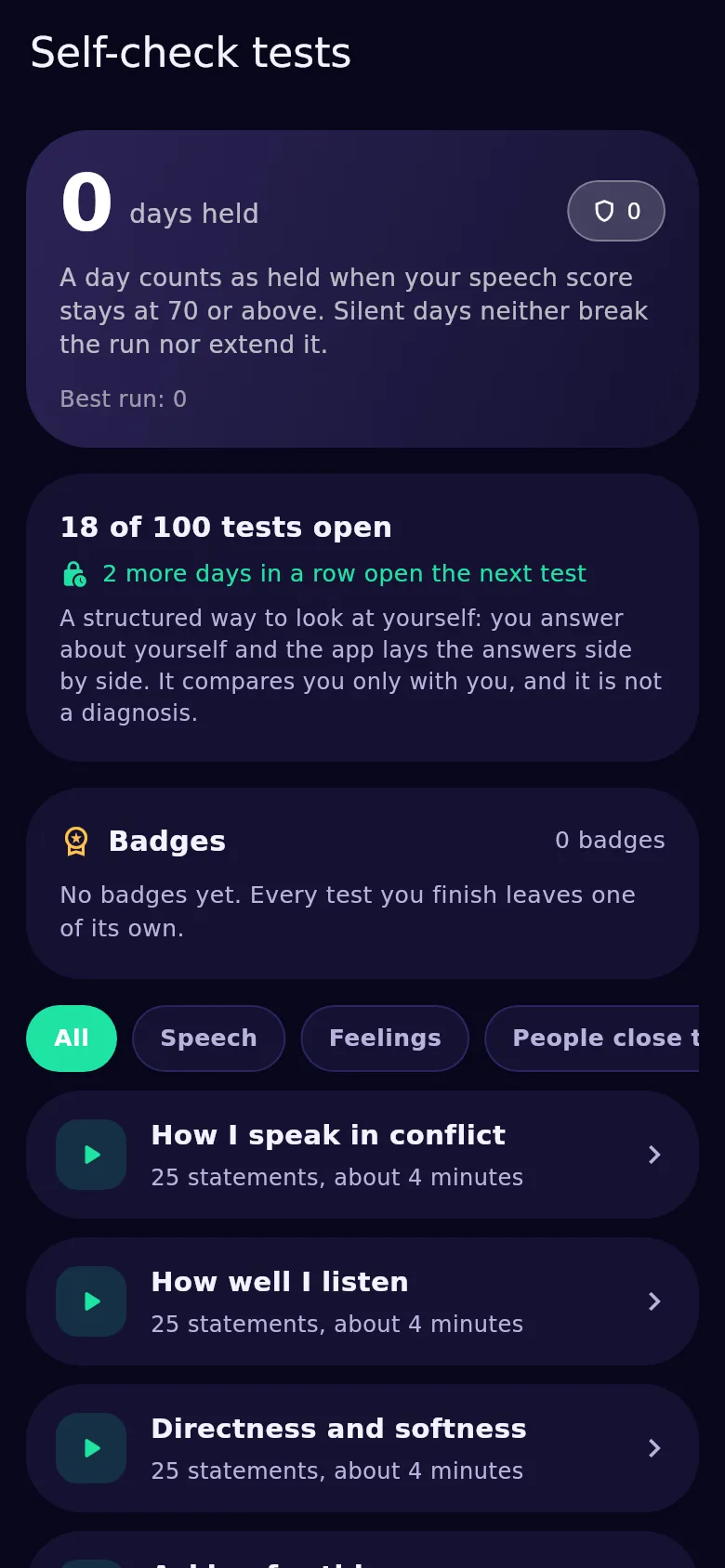
The “what kind of conversationalist are you” quiz you find online hands out four personality types and nothing more. Kyndsy has a hundred tests, each with 25 statements and five facets scored separately, and one takes about four minutes. The difference is not the number: the result here is not a verdict but your own answers, laid out side by side.
How one test is built
Twenty-five statements, answers on a scale, five facets of five statements each. At least six statements are reversed: on those, “exactly me” is the worse answer, not the better one. Without them a test measures not the person but their wish to look good.
One statement per screen, and the screen does not scroll. A list you have to crawl through turns four minutes into twenty — and the crawling is worst on the long statements, which are the important ones.
It is not a diagnosis and not a measurement of personality
The app says so plainly on the tests screen. None of the hundred diagnoses anything, compares you with other people, or hands you a “type”. It sorts your answers into facets and shows where they disagree with each other.
The disagreement is the useful part: “I always let people finish” next to “I often finish other people’s sentences” is not a flaw in the test — it is the reason to take one.
Half are unlocked by work, half are bought
Ten are open from the start. Twenty-five open through holding — days on which you kept to your level; fifteen through levels; fifty are sold. That split exists so the app does not turn into a shop window with everything interesting behind glass.
Behind those fifty sit four products, not fifty: three bundles and “any one test”. And the product sells an unlock, not a particular test — which one to open you choose yourself in the app, after the purchase.

The badge is for taking the test, not for the score
Every completed test has its own badge. It is given for finishing, not for how it came out: a badge that turned red on a low score would be telling you who you are supposed to be — and the next test you took would no longer be about you.
Badges hold no data of their own: they are a retelling of your result history and disappear with it if you delete it. The drawing comes from the motif of the test itself and does not move on the badge — a hundred animations on one screen heats the phone.
A completed test buys back one broken day
This is the one place where tests meet the holding streak. A completed test cancels one missed day — free, no more than once a week, and only across different tests.
The limits are not arbitrary: one test on repeat would mint endless days, and twenty-five statements in exchange for a streak stops being a measurement of behaviour. And exactly one day is cancelled: a longer gap can only be bought back whole, and the screen says so in words.
One hundred ways to look at yourself
Reading about it is one thing. Ten of the tests are open right here — no install, no account, nothing saved.