 Skip to content
conversation rehearsal
Rehearsing a hard conversation: the app listens and records nothing
Before a hard conversation, an interview or a talk, you can say it all out loud first. The rehearsal counts pace, pauses and fillers — and writes not one line into your day.
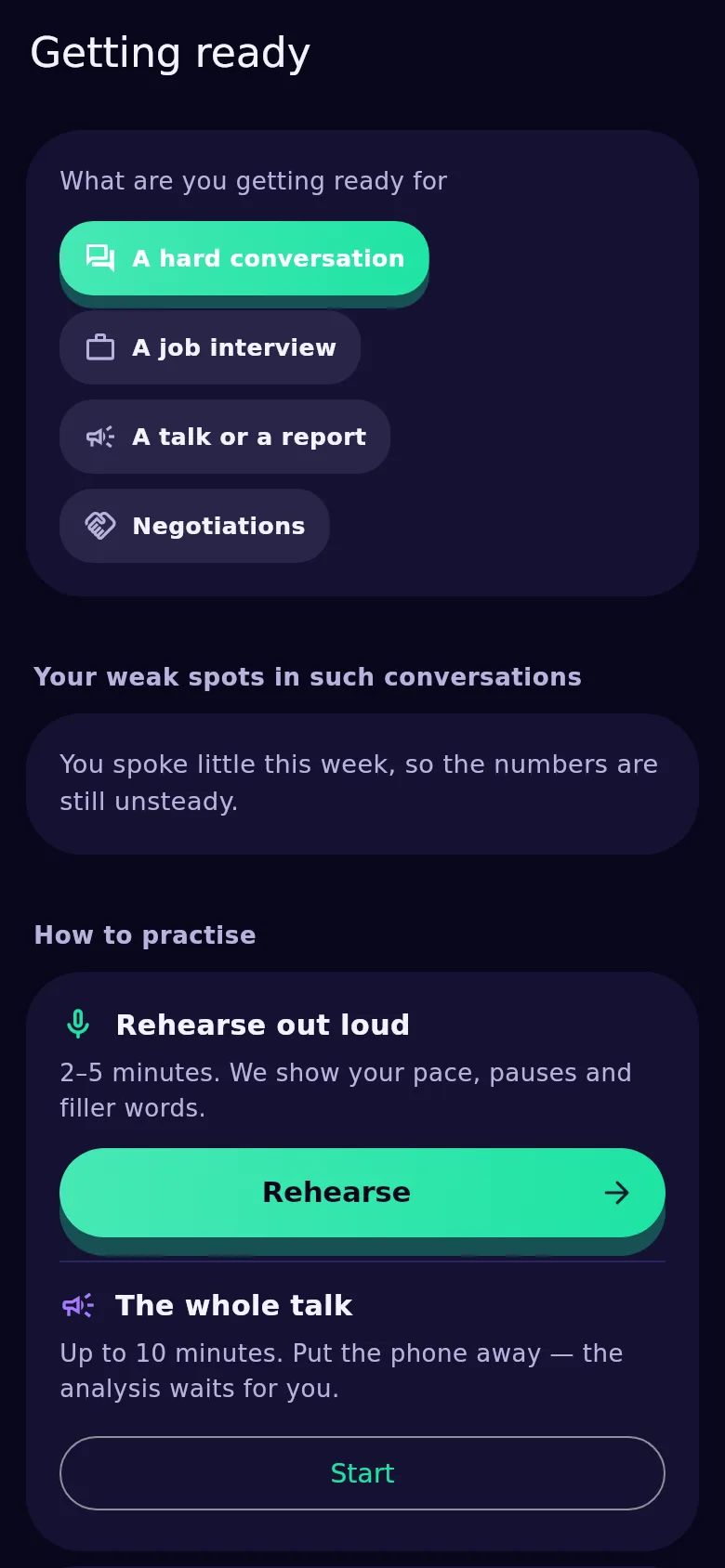
The hardest part is not the conversation but its first thirty seconds: the sentence you prepared sounds smooth in your head and falls apart out loud. Kyndsy has a place to say it in advance: rehearsal. The app listens and counts — pace, pauses, fillers, turn length — and writes nothing into your day.
Four occasions, and they are not the same
A hard conversation, an interview, a talk, a negotiation. The app asks what you are preparing for, because the hints differ: in a hard conversation it is turn length that gets in the way, in a talk it is pace, in an interview it is fillers.
Next to that sit your weak spots in that kind of conversation, taken from your own numbers. If there is not a week of them yet, the app says so: there is nothing to compare against.
The rehearsal records nothing — and that is enforced by a type, not a flag
The speech pipeline holds not a store but a sink. Rehearsal is handed a sink without a database: there is simply nowhere for events to go.
A flag saying “if rehearsing, do not write” would hold exactly until the first new line written past it — and would stop holding silently. So it is a type here, not a condition: “it recorded by accident” does not exist by construction.
The attempt review: numbers, not a verdict
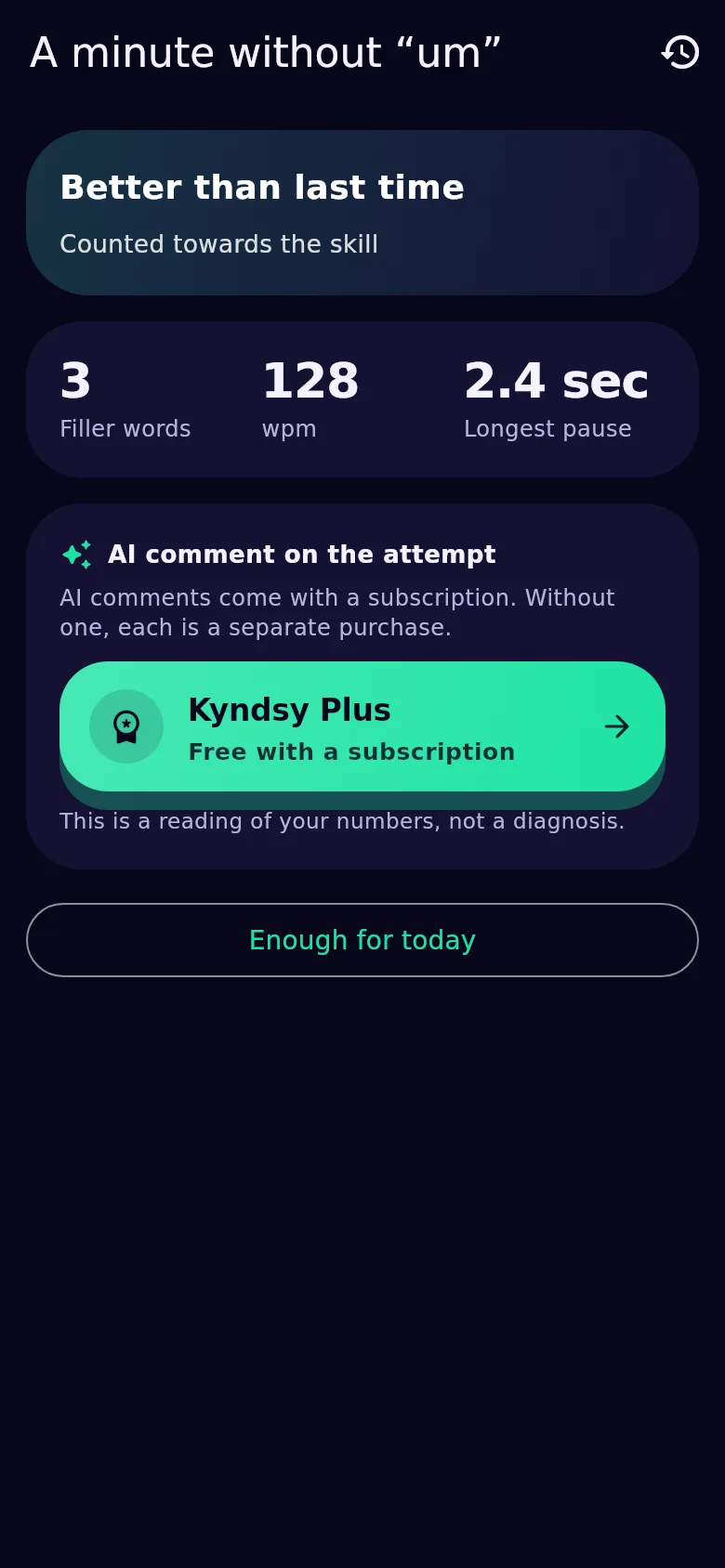
After a rehearsal you get what you get after an exercise: how many fillers, what pace, the longest pause, turn length. And one piece of advice rather than a list: the one that gets in the way most.
The numbers are compared with nobody’s but your own. There is no “correct” pace — there is your usual one and today’s.
Presentation mode: speak for as long as you need
A talk works differently. There is no time limit here and no requirement to look at the screen: the phone can stay in your pocket and the review will wait for you.
The same things are counted, and just as before nothing reaches your day. The point is to run the talk whole rather than in pieces — and to see where the pace ran away in the third minute rather than the first.
What rehearsal does not replace
It does not tell you what to say: the app does not invent words for you. And it does not promise the conversation will go well — that does not depend on you alone.
It gives one thing: the chance to hear yourself before someone else does. Usually that is enough for the first thirty seconds to stop being the hardest part.
One hundred ways to look at yourself
Reading about it is one thing. Ten of the tests are open right here — no install, no account, nothing saved.