 Skip to content
voice
Your voice gives out by evening: what a phone can measure and what it cannot
Hold, resting pitch and steadiness — what the app really hears through a microphone, and what it could not invent even if it wanted to.
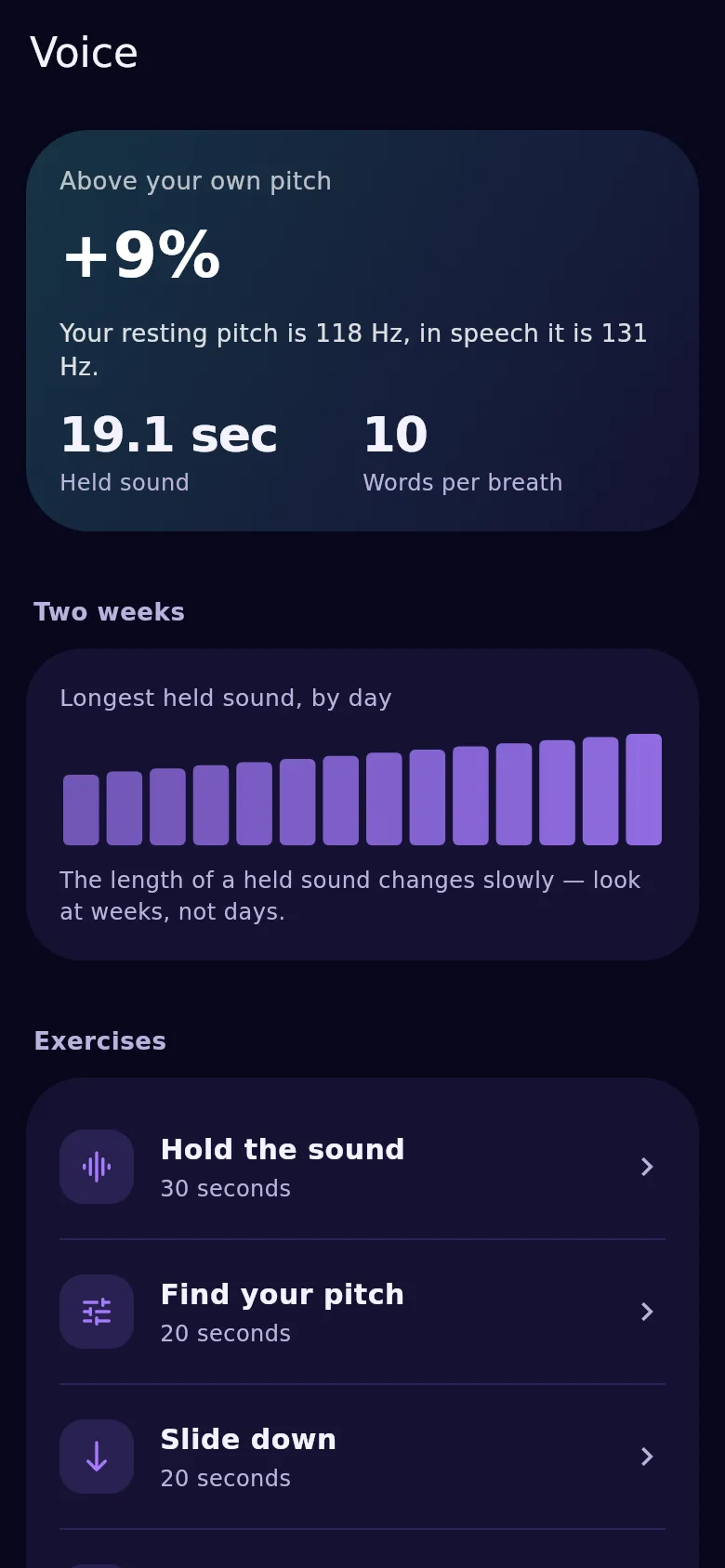
By evening your voice gives out; by the end of a meeting it climbs; halfway through a long sentence the air runs out. Anyone can hear it — and almost nobody can pin it down: “I sounded tight today” is a feeling, not a number, and there is nothing in it to argue with. The app counts sound: how long you hold a tone, how steady it is, how high you speak, and how many words you fit between breaths.
First your own pitch, not a “correct” one
Everything else is measured from one point: the resting pitch at which your voice sounds without effort. You find it by humming — half a minute with your mouth closed, with no target to hit. The app takes the median and remembers it.
Until that point exists, strain is not counted and not shown. A number with nothing to compare it to is decoration, not measurement: one person sits at 96 Hz and another at 210, and the only “normal” here is you a month ago.
Hold: how many seconds you carry a sound
Hold in this app is not about the diaphragm; it is about duration — the longest unbroken voiced sound in a day. Eleven seconds do not become nineteen in one evening, but a fourteen-day chart shows the movement before you can hear it.
Next to it sits steadiness. Pitch jitter is about 0.02 in a calm sound and two or three times that in a tight one. This is exactly what people mean by “my voice was shaking” — now the feeling has a number.
Strain is a comparison, not a diagnosis
When you speak noticeably above your resting pitch, the app says so: today you were this much higher than usual. It does not say “your larynx is constricted” and does not recommend treatment — it compares you with yourself.
If a high voice holds for weeks and does not drop even on calm days, the screen points you to a doctor rather than an exercise. That is the one situation where the app stops coaching and tells you to stop too.
What a microphone cannot see — and we do not claim otherwise
Breathing, the position of the diaphragm, the work of the larynx, tension in your shoulders: a microphone does not measure any of it and cannot, because it stands outside. All it can report is how the result sounds.
That is why there is no anatomy in the wording of that screen, and the same instruction goes to the AI review on our server: talk about sound, do not diagnose. An app that promises to “fix your breathing” through a microphone is promising something it does not have.
Words between breaths — the most practical number of the four
How many words you get out on one exhale is the thing a listener notices before pitch or steadiness. Short phrases pushed out on the last of the air sound like alarm, even when you are perfectly calm.
It is also what ties voice to the rest of your speech: turn length, pace and pauses are counted in the same conversations as the rough and polite words. Voice is not a separate drill in front of a mirror — it is part of how you are heard.
One hundred ways to look at yourself
Reading about it is one thing. Ten of the tests are open right here — no install, no account, nothing saved.