 Skip to content
swearing
A swear and filler word counter that only counts your own voice
How to stop swearing and drop filler words when the counting is honest: the app listens all day, tells your voice from everyone else’s and keeps no audio at all.
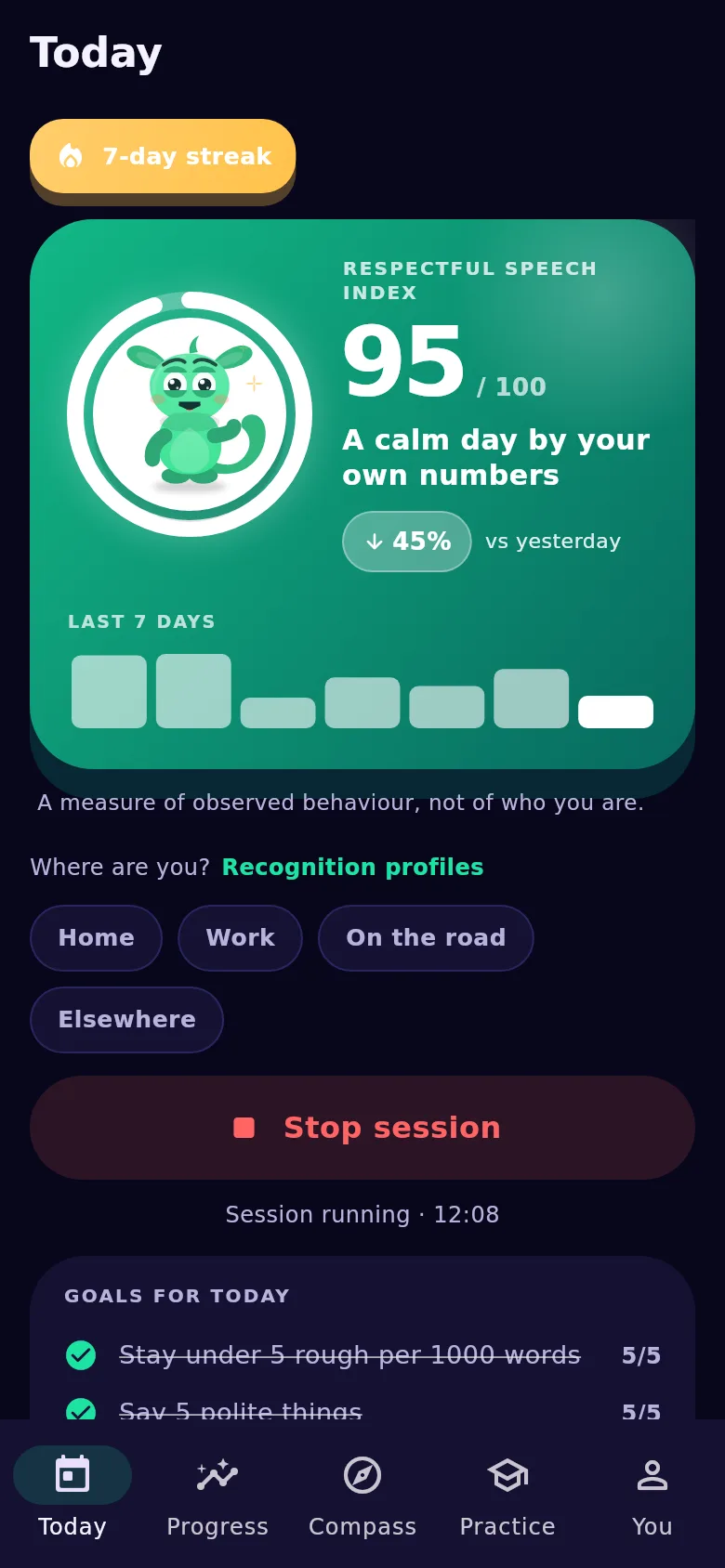
“I hardly ever swear” — almost everyone believes that until they count. The first honest week usually ends in surprise, not because the person is worse than they thought, but because a habit is invisible from the inside. Kyndsy counts swearing, filler words and warm words on the phone itself and shows a trend, not a verdict.
Why “just stop” does not work
Swearing and filler words are not a decision. They are an automatism that fires faster than thought — when a person is tired, in a hurry, or has just been interrupted. A promise to stop on Monday loses to that speed, not to weak character: the decision arrives after the word is already out.
What does work is seeing where and when it happens. Not “I swear a lot”, but “Thursday evening after work, twice as often as usual”. At that point the habit stops being a personality trait and becomes a circumstance with a time and a place.
What the app actually counts
Three directions at once, and that is deliberate. Harsh — swearing and insults. Fillers — “um”, “like”, “you know”, “basically”. Warm words — thanks, apology, request, praise. An app that counts only the bad half is an app that tells you every evening what a bad person you are; it gets deleted on day three.
Numbers are shown per thousand words spoken, not as raw counts. Twelve swear words means nothing without knowing how much was said: on a silent day a raw counter shows progress that never happened. Per thousand words is comparable between a Monday and a Saturday.
Only your own speech is counted
This is the real difference from “swear detectors” that count everything the microphone hears. Kyndsy first compares the voice with your own sample and only then sends the fragment to recognition. A stranger in a café, a series on TV and the person across the table are not counted.
The order matters more than it sounds. Verification comes before recognition: anything not recognised as your voice never becomes text at all. That is not an optimisation, it is the promise — the app does not parse other people’s speech even in passing.
No audio ever leaves the phone
Recognition runs on the device. Sound lives in memory for seconds, turns into counters and is gone: no files, no transcripts, nothing sent to a server. There is no account — only a random id created on this phone and linked to nothing.
You can check it the simplest way there is: turn the internet off. The counters keep working, because they have nothing to send.
What happens after two weeks
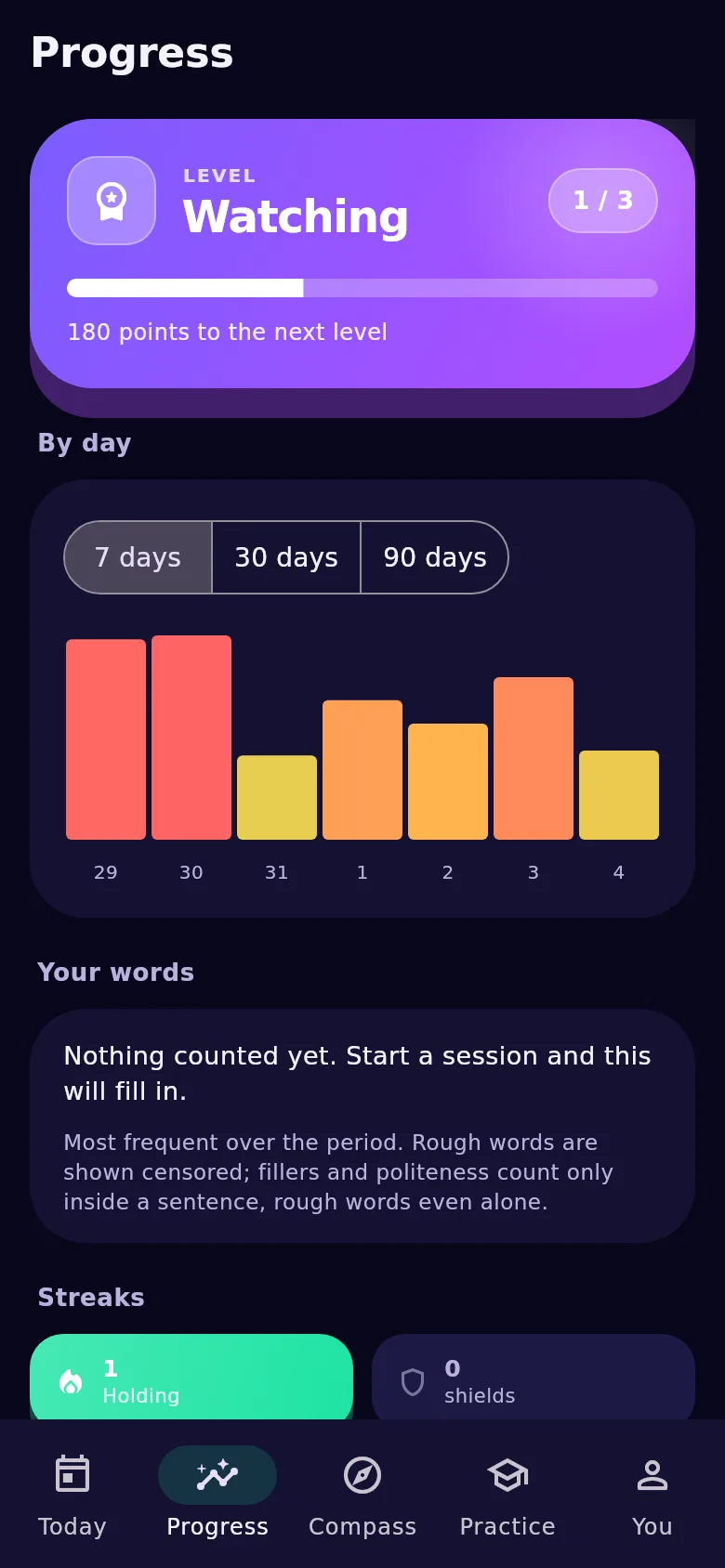
The first week is measurement: people learn their real numbers and usually stop arguing with them. The second week brings the first changes — the app shows that evenings are harder than mornings, and that conversations at home differ from conversations at work.
After that the work is done by the coach, not the counter: one habit at a time, a short spoken exercise every day, and progress measured by what changed in real conversations rather than by taps on a button.
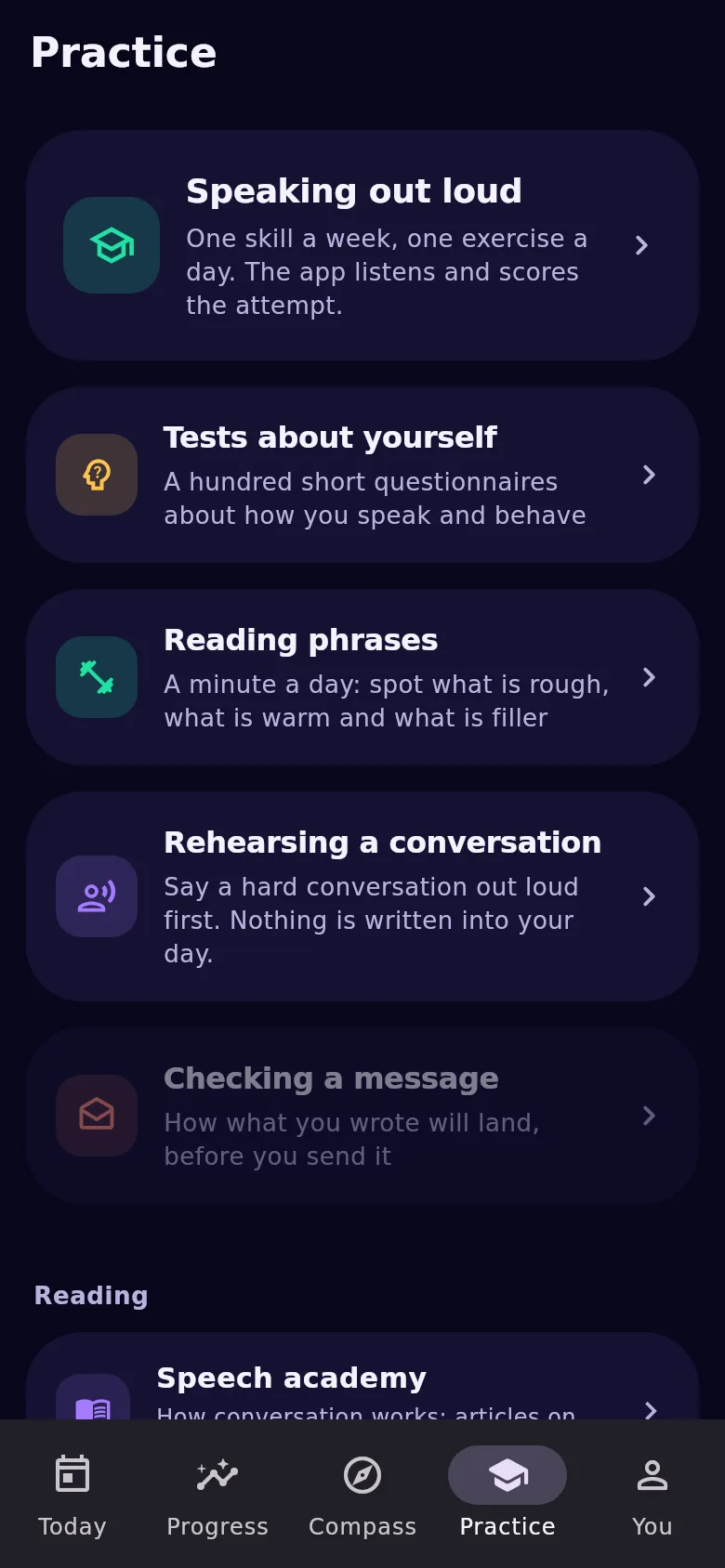
One hundred ways to look at yourself
Reading about it is one thing. Ten of the tests are open right here — no install, no account, nothing saved.