 Skip to content
monthly review
A letter about the month and a map of the quarter: a long read instead of another chart
Charts answer “how much”. The letter about the month and the map of the quarter answer “what changed and what did not” — in a long text you read once and remember.
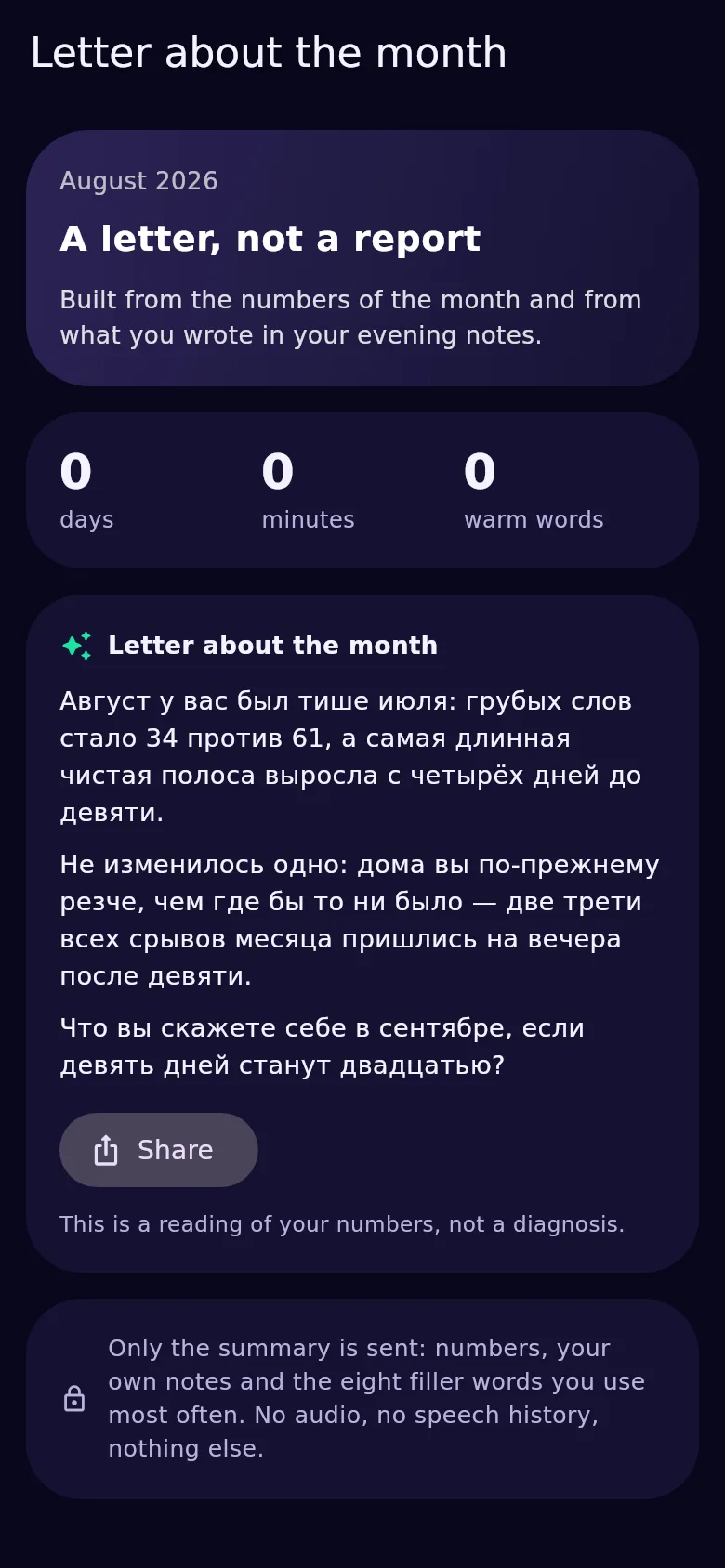
By the end of a month the app holds thirty days of numbers — and, along with them, a feeling that there is nothing left to look at. Numbers answer “how much”, but by then the question has changed: what shifted, what stayed the same, and what to do about it. Two long reviews answer that: a letter about the month and, once a quarter, a map of your speech.
Why a text and not another chart
A chart shows movement but never names the reason. “Fewer sharp words” is a line going down; “fewer everywhere except evenings after nine” is a conclusion, and you cannot draw it as a bar.
The letter about the month runs 700–900 words. It is built on your numbers for the month and on your own notes where you wrote any: it compares the month with the previous one, names what did not change, and ends with a single question rather than a list of tips.
The map of the quarter: three months and what only they show
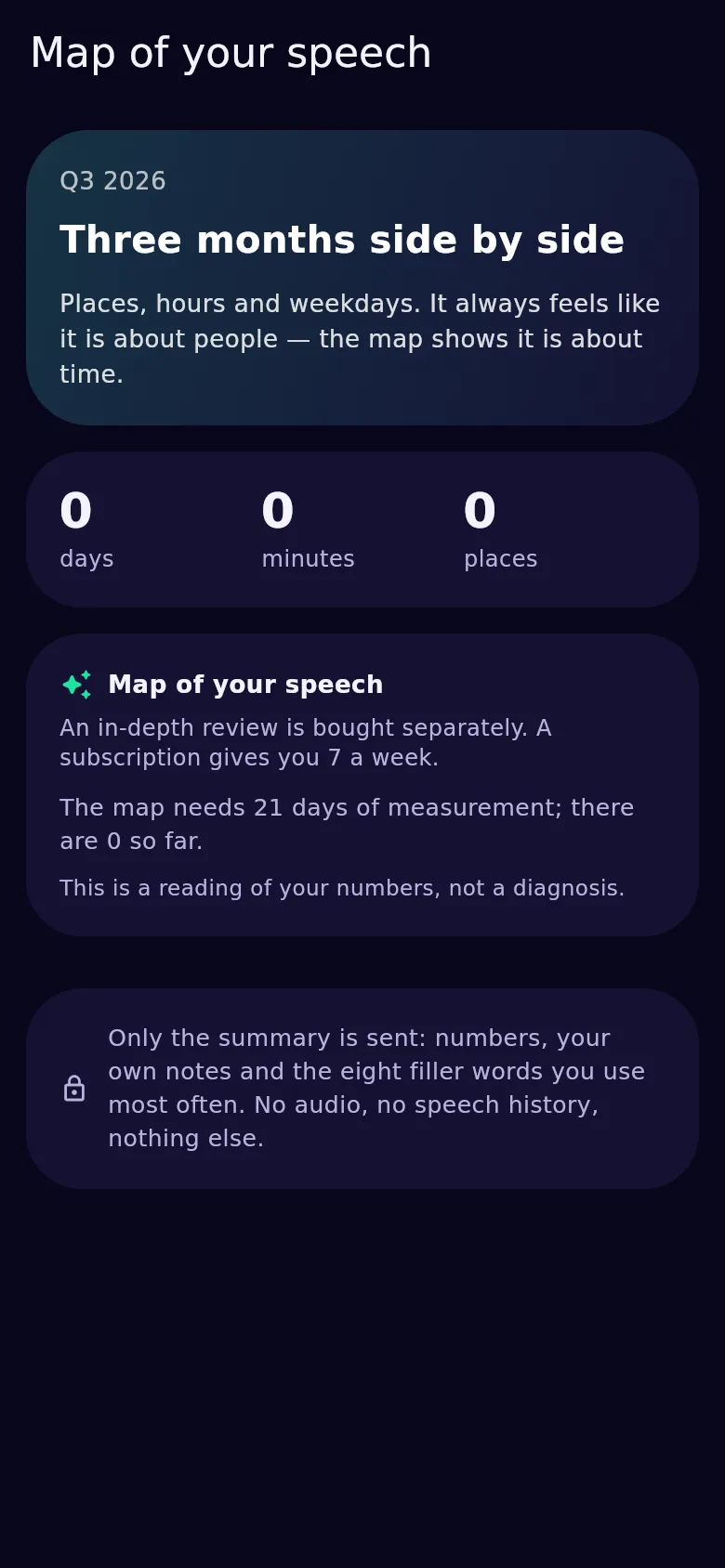
A month is too short for some things. One bad week inside a month spoils the whole month; across three months you can see whether it was an accident. So once a quarter the app assembles a map of your speech — a review of the same length at a different scale.
The map needs at least 21 days of measurement, and that threshold sits both on the screen and on the server. Selling a review with nothing to review is not on: the app simply does not offer it until the days are there.
Why these cost money and the short reviews do not
Reviews come in two classes. Short ones — five lines about a practice attempt, your voice, your conversations, your evening summary — are part of the subscription and are never sold one by one: a dollar for five lines would be a swindle, and we would get exactly the reviews we deserved.
Long ones — a test review, the monthly letter, the quarterly map — are bought separately. And the server guarantees it: if the model answers too briefly, the request is retried, and failing that the purchase is not spent at all — the app says so in words.
What leaves the phone and what does not
A summary leaves: the numbers of that month or quarter and your own notes where you wrote any. No name, no audio, no transcripts, no speech history. Every request needs its own tap on a screen that says exactly what will be sent.
The finished text is kept for 30 days — so the app can show it again after a dropped connection — together with the identifier of the receipt that paid for it. Then it is deleted. A repeat of the same request is free: a broken network should not cost money.
What to do with it
Doing nothing is also an answer. The letter hands out no assignments and sets no goals: it describes a month, it is not a plan for the next one. If it leaves you wanting to change something, the app has a skill of the week and a word of the week — that is where the assignments live.
And one rule worth remembering: the text is built on numbers, and the numbers are built on measurement. A month in which you barely ran a session produces a short, careful letter — and that is more honest than a beautiful text about nothing.
One hundred ways to look at yourself
Reading about it is one thing. Ten of the tests are open right here — no install, no account, nothing saved.