 Skip to content
speech drill
A drill with no microphone: ten tasks for when you cannot speak out loud
On the train, at work, at night beside someone sleeping — speaking out loud is not an option. The drill works in silence: spot the rude phrase among lookalikes, say it more softly, find the one word that makes a sentence sharp.
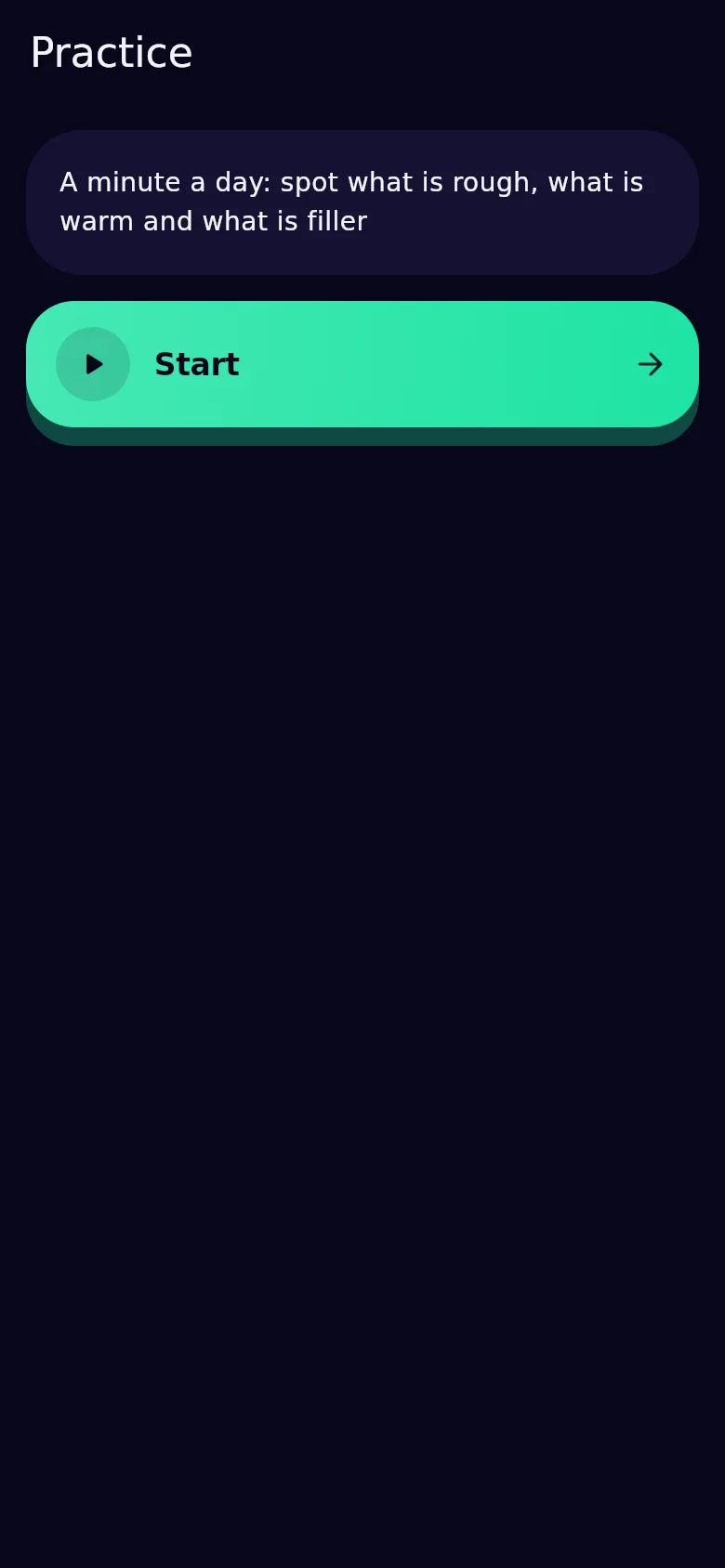
Half of the app needs your voice — and half of the day happens where speaking out loud is impossible. The drill is the one part of Kyndsy that works in silence: ten tasks, a couple of minutes, microphone off. And it is not a “lite mode”: it trains something the spoken exercises do not train at all — recognition.
Three kinds of task, all three about recognition
First: among four phrases, find the one that is not rude. Second: pick how to say the same thing more softly. Third, the hardest: point to the one word that makes the sentence sharp.
The third kind exists because the first two could be solved at a glance: wrong options are now picked to be closest to the right one by shared words, and the phrases for “one word” are borderline — ones where no single word on its own carries the sharpness.
The set changes every day
Tasks are assembled fresh each day, and the order comes from the date. That is not decoration: without it, someone who got a task wrong would close and reopen the screen until the same one came back, and the drill would become a memory test.
Ten tasks take two or three minutes. More is not needed: recognition is trained by frequency, not by the length of a set.
There is no profanity in the drill, and no word stumps
The profanity direction is excluded entirely. The drill shows phrases to a person on a screen, and showing something to a person is not the same as counting it.
And there are no bare word forms: in live speech they are caught, but on a screen they look like fragments of morphology rather than something anyone says.
The drill earns neither streak days nor badges
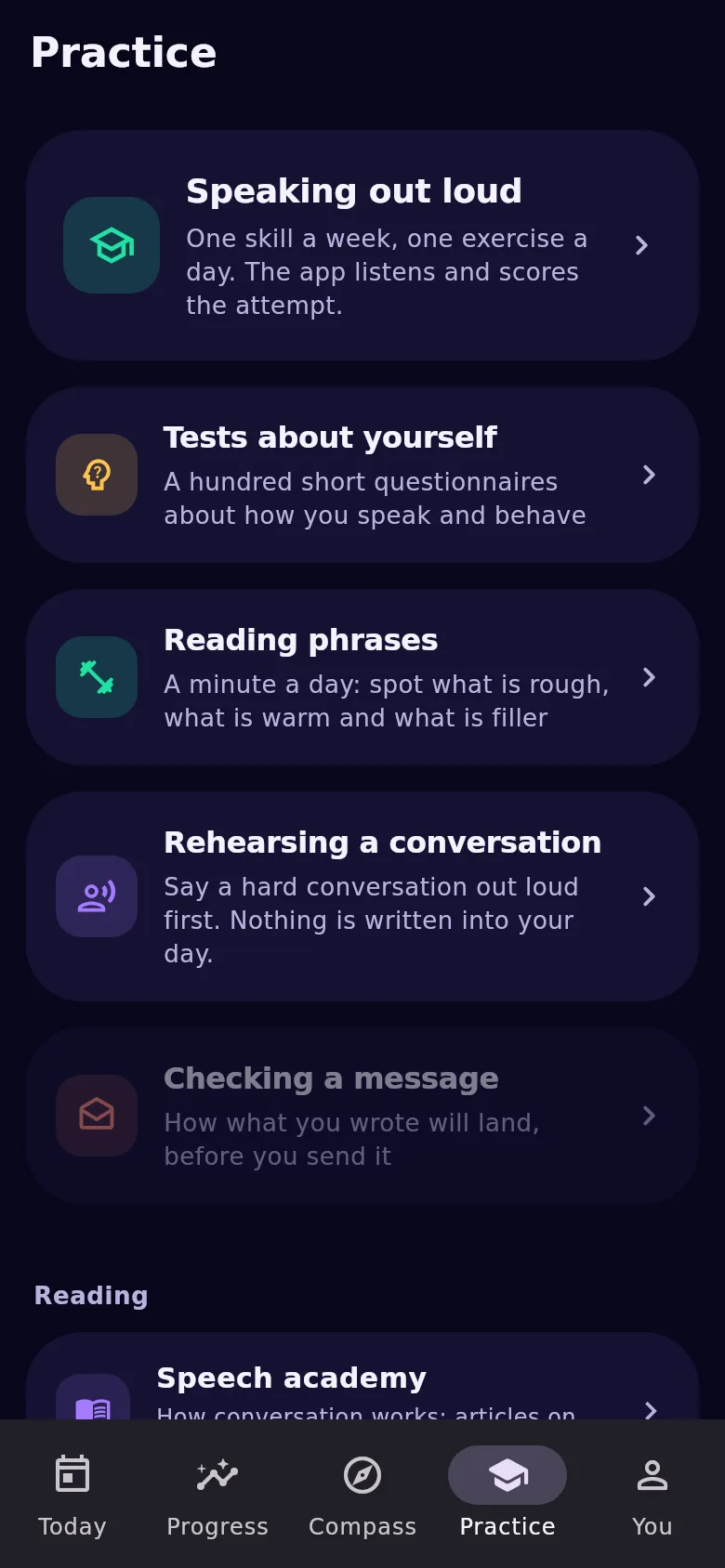
That is a decision, not an omission. The streak measures speech: a day earned by tapping a screen would turn it into a measure of diligence, not of behaviour. The same goes for badges.
The drill gives something else: it is free, it needs no subscription and no voice. It is what you can fill five minutes in a queue with, without turning those minutes into currency.
It works in every one of the thirty languages
That had to be fixed separately. A phrase was defined as “a string with a space” — but Japanese, Chinese and Thai are written without spaces, so those languages found no tasks at all; Belarusian dropped out entirely for want of a single kind.
The marker now comes from the catalogue block, and a language loses only the task it has nothing to build from. The rule is wider than the drill: a marker guessed from the text breaks on the first language with a different script.
One hundred ways to look at yourself
Reading about it is one thing. Ten of the tests are open right here — no install, no account, nothing saved.