 Skip to content
conversation
Who talked longer: your share of the time, interruptions and turn length
Three numbers about a conversation nobody can recall on their own: how long you spoke, who cut across whom, and how long your turns were. And why none of them has a correct value.
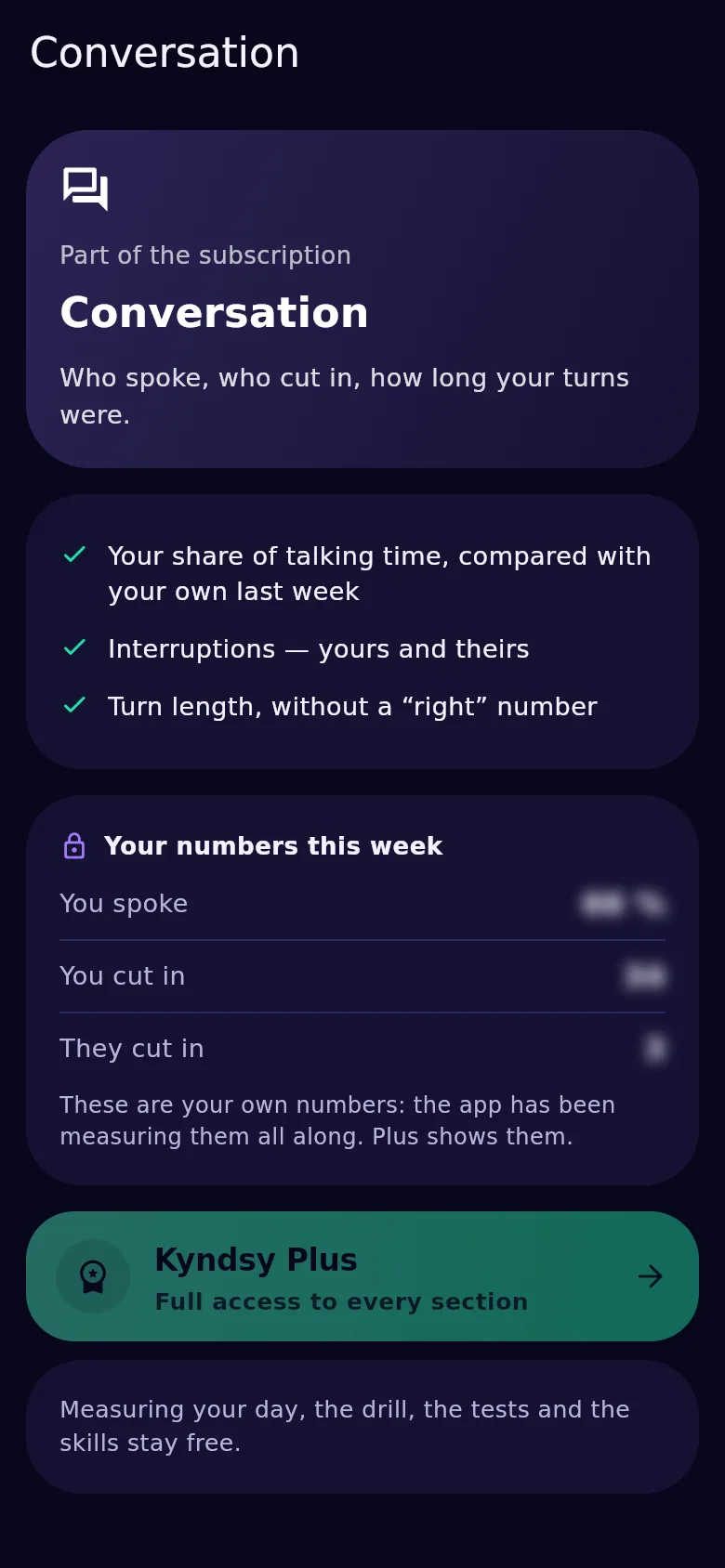
What survives a conversation is a feeling, not numbers. “I think I listened”, “he always cuts me off” — and there is nothing to check it against: nobody records anything, and memory bends the whole conversation towards however it ended. Kyndsy counts three things: how long you spoke, how many times speech overlapped in each direction, and how long your turns were.
Your share of the talking — and why fifty-fifty is not the goal
The app splits the time into “you” and “not you”: your own speech is recognised by voice, everything else simply goes into a time counter and is never analysed further. What comes out is a share — how many minutes of the hour were yours.
It has no correct value, and that number is nowhere on the screen. Eighty per cent in a meeting you are chairing is normal; the same eighty in a conversation with someone who came to tell you about their trouble is another matter entirely. The number answers “how much”, not “was that good”.
Interruptions are counted in both directions
An interruption is overlapping speech: two people talking at once for longer than a short “mm-hm”. What you did and what was done to you are counted separately, and the two numbers sit side by side.
That is how the great self-deception of conversation disappears: “people keep interrupting me” is checked on the same screen as “I never interrupt anyone”. Usually neither number turns out to be zero, and that is the most useful thing you will learn in a week.
Turn length: monologue and clipped answers are the same mistake
The average length of your turn says more about a conversation than the share does. Three seconds at a time means clipped answers with nothing in them for the other person; forty-five means a monologue they are not let into.
The numbers sit next to the share on purpose. Twenty per cent of the time in short turns and twenty per cent in one block are two completely different conversations at the same share.
What the app does NOT do in a conversation
It does not analyse what you talked about and does not decide who was right: the content of the conversation is none of its business. The other person’s speech is never recognised at all — voice matching runs before recognition, and their words go nowhere.
No audio and no transcript survives: what the database holds is minutes, a count of overlaps and the length of turns. The conversation cannot be reconstructed from those numbers — and that is not a limitation but the condition on which the app listens at all.
Why keep numbers with no right answer
For the same reason you keep a scale: it does not tell you who to be, it shows movement. This week against last week is the only comparison that means anything here.
And because a conversation is the one place where your speech meets someone else’s. Everything else the app counts is about you; this is about how you share the time with the person in front of you.
One hundred ways to look at yourself
Reading about it is one thing. Ten of the tests are open right here — no install, no account, nothing saved.